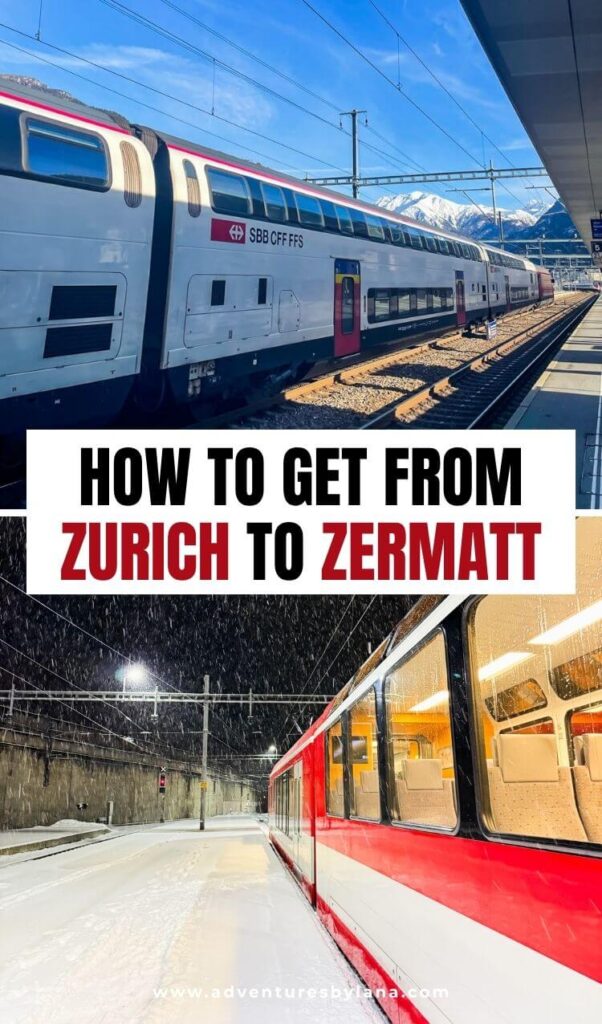
Zurich to Zermatt by Train: Tickets, Routes + Tips to Save Money!
Switzerland is without a doubt one of the best countries to embrace train travel!
After taking various trains in manyyyy different countries over the years, I was so impressed by the cleanliness, punctuality, and ease of use of the trains throughout Switzerland. It even rivaled Germany!
So, when it came time to make the journey from Zurich to Zermatt on my last trip to Switzerland, the train was the obvious choice.
But all of the decisions after that became a little overwhelming…
What station do we leave from? How many transfers are there? What type of ticket do we need? What is a reasonable cost?
After a lot of researching (like a lot), we had a very smooth journey from Zurich to Zermatt, and now I am sharing all of those details with you!

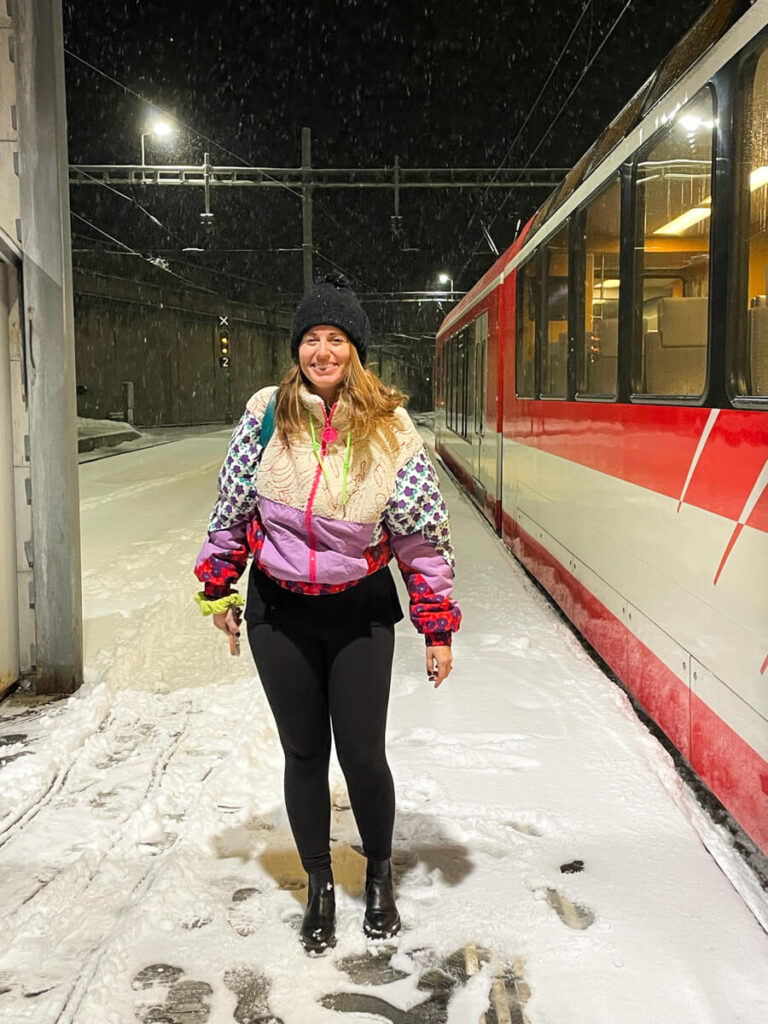
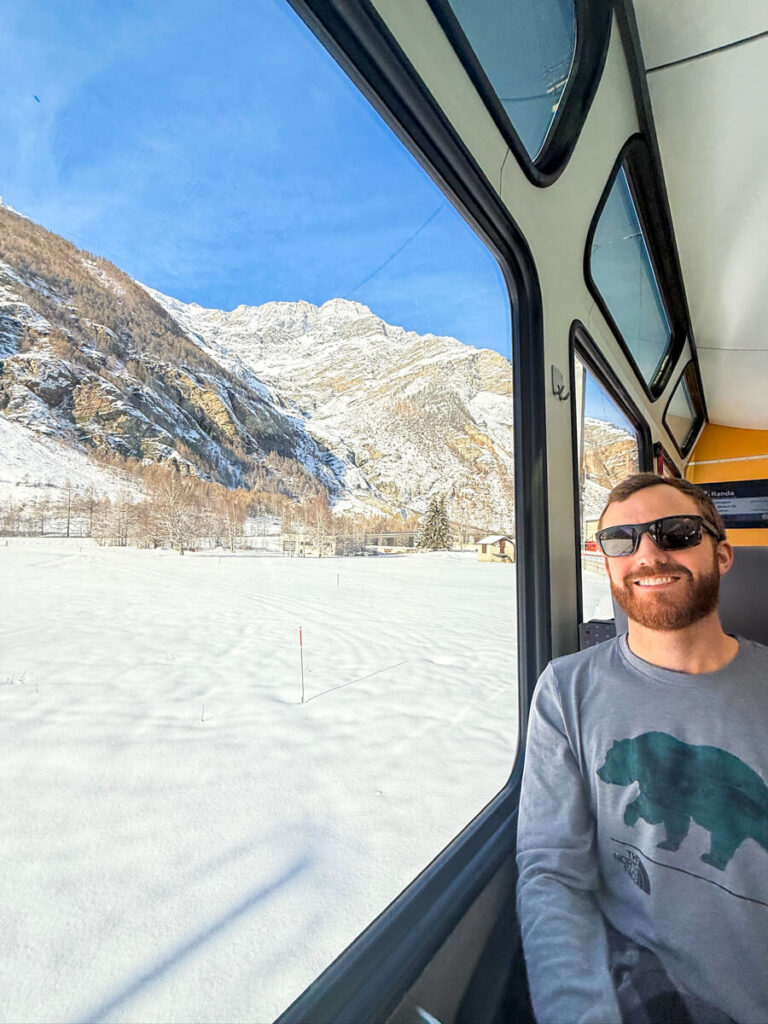
Happy as a clam, on our way to Zermatt from Zurich! 
Arriving in Zermatt very underdressed
🚊 Zermatt to Zurich by Train Quick Facts:
⏱️ Time: about 3 to 3.5 hours
🔁 Changes: 1 (in Visp) on the best routes, sometimes 2–3
💰 Cost: from CHF 52 with a Saver Day Pass, or about $100+ for a regular ticket
🎟️ Book: Omio or the SBB app
Zurich to Zermatt Train Routes
The train journey from Zurich to Zermatt takes between 3 hours and 15 minutes to 3 hours and 45 minutes, depending on your departure point and how many transfers you have.
The standard routes run between 6:00am to 8:30pm, with trains departing every 30 minutes to 1 hour.
When buying your train tickets, I highly recommend prioritizing the route with the fewest amount of transfers on the journey.

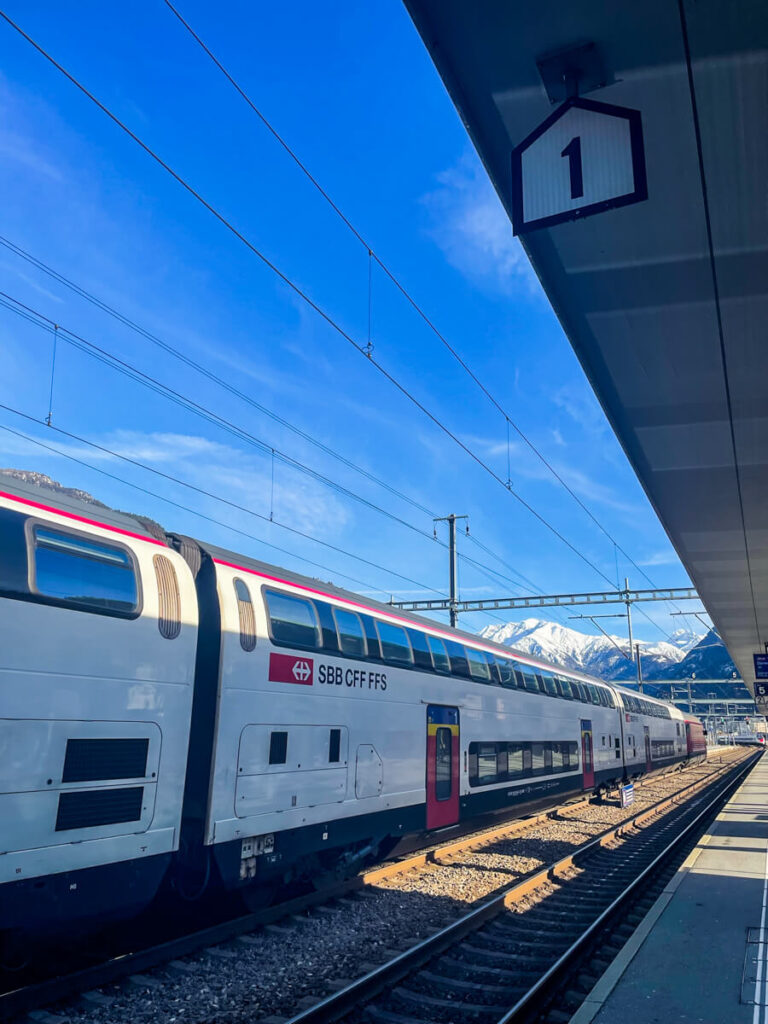
Not only will this make the journey slightly shorter (sometimes), but it’s much less stressful to only have to worry about changing trains once, versus two or three times.
How do I know this?! Our original route only had 1 transfer, but after my friend’s flight was delayed, we ended up on a different route with 2 (very short) transfers, which added a little stress to the journey.
⏰ Note: It is extremely common for transfer times on Swiss trains to be 10 minutes or less, sometimes even 5 minutes! This felt very short to us, but everyone assured me that the Swiss have things timed perfectly, and you do not need to worry about missing your train. While we did make all of our trains, we knew exactly which platform we were going to before getting off and beelined it straight there at a brisk walk lol.
For Zurich to Zermatt, you can expect to have between 1 to 3 transfers. The earlier you book, the better odds you will have of only having 1 transfer!
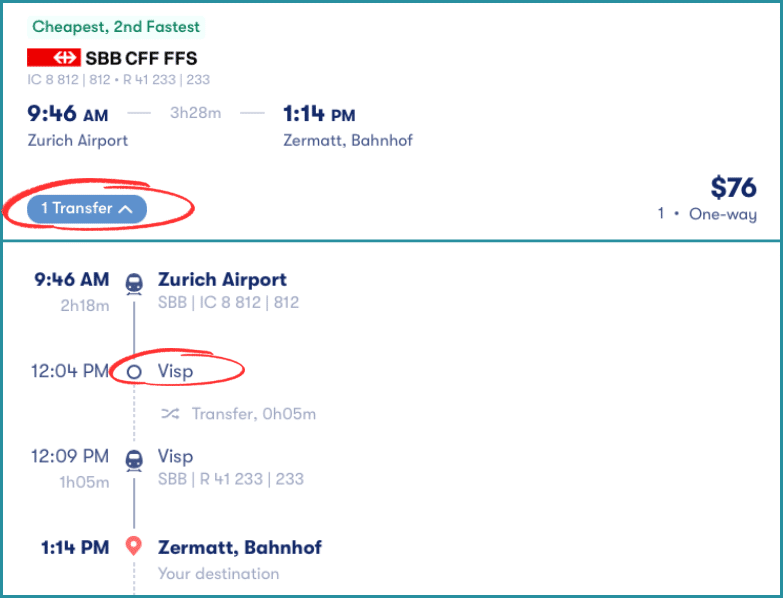
But no matter what route you choose, almost all will require a transfer in Visp. From Visp, you’ll board the iconic red Matterhorn Gotthard Bahn to complete the final 1 hour 5 minute journey to Zermatt!
Other common transfer points include Bern or Zurich’s main station (if you are departing from the airport).

Train route from Zurich to Zermatt with stop in Visp 
Matterhorn Gothard Bahn at the Zermatt train station

Departure Point: Zurich Airport or Zurich Train Station?
If you are traveling from the bustling Zurich to the cozy Zermatt, you have two main options for your journey’s departure: the Zurich airport station or the Zurich main station.
While both options are suitable for getting to Zermatt, I recommend choosing the easiest one for you.
If you are arriving by train to Zurich, you should look for tickets from Zurich’s Main Station (Zürich HB).
If you are arriving by plane to Zurich, you should look for tickets from the Zurich Airport Station (Zürich Flughafen).
Both departure stations have a few different routes per day with just 1 transfer in Visp.
However, the route from Zurich’s main station to Zermatt is about 10-15 minutes shorter than from the airport station, since the main station is further south than the airport (on the way to Zermatt!).
Since we were flying into the Zurich airport and starting our journey to Zermatt immediately, we opted for the route directly from the airport to Visp to Zermatt. This was so we didn’t have to worry about first traveling to Zurich’s main station and then starting our journey from there.
But if you are spending a few days in Zurich, it will be faster to book from the Zurich main station (the cost will typically be the same).
Purchasing Your Tickets
One of the most confusing parts of train travel in Switzerland is the different ticket options. Should you buy point to point tickets for each journey? Or purchase the all-inclusive Swiss Travel Pass for the whole trip?
To be able to answer this question, you need to have your trip to Switzerland mostly planned. By that I mean – you need to know which cities you will be visiting, how often you will be taking trains, and what excursions you are interested in.
This is because different travel cards and routes have different cos AND the two main travel cards (the Swiss Travel Pass and the Half-Fare card) offer discounts on certain mountain excursions, scenic train rides, and museums.
I will give you a brief overview of these two cards below, but I will caveat it with the truth that we did not use either of them. For our 7 day trip to Zermatt and Basel, the savings did not justify the cost of either card/pass.
Instead, we purchased Saver Day Passes for our two main train journeys from Zurich to Zermatt and Zermatt to Basel for $63 each way. This was the cheapest option for us!
Depending on your itinerary and when you book, your version may look different. I’ll break down how to decide below!
Save this post for later!
Saver Day Passes (What We Used!)
So what are Saver Day Passes? Well, they are exactly what they sound like: a one-day train ticket designed to save you money!
This ticket can be used for an entire day + up to 5am the following day on all trains, trams, boats, buses, etc. in the GA area (view the map here).
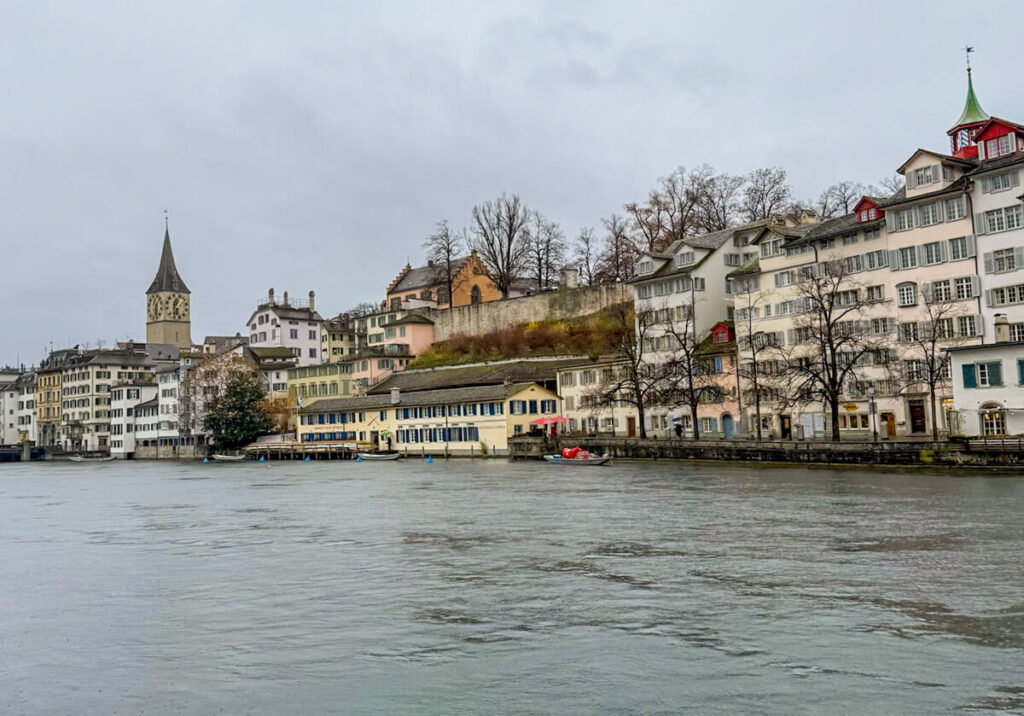
For example, if you purchase this ticket for your journey to Zermatt, all of your train travel in Zurich that day will also be covered (we took advantage of this and visited the Zurich Christmas markets while waiting for our friend’s flight to land!)



Taking advantage of our delay in Zurich by visiting the Christmas markets!
Saver Day Passes are available for purchase from 6 months to 1 day before your journey. However, for the best rates, you should book them as early as possible.
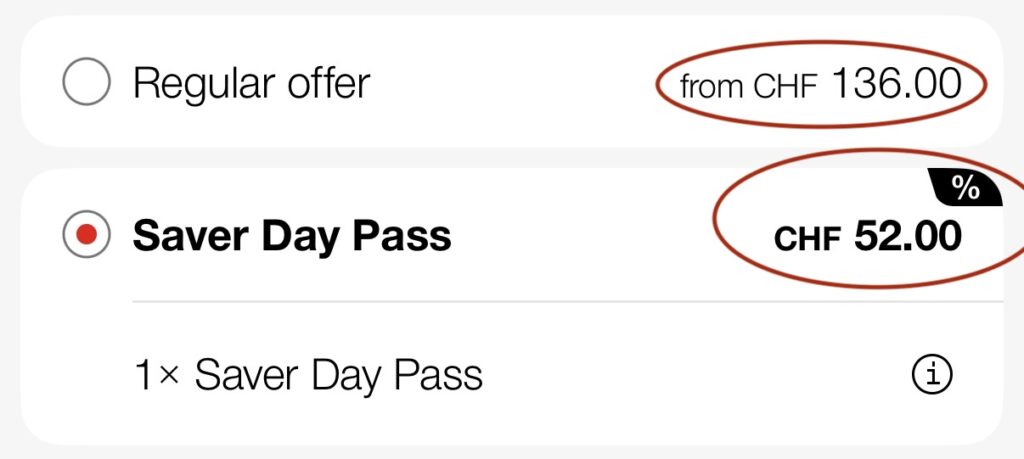
For the journey from Zurich to Zermatt, a Saver Day Pass ticket can be as low as CHF 52, aka $63 USD. (I recognize this is still pricey, but for Switzerland, it’s very reasonable!).
On the other hand, when buying a normal ticket from Zurich to Zermatt a few days in advance, you can expect to be $150 or even $175!!!
So, Saver Day Pass tickets can be less than half the cost of the normal ticket, aka definitely worth securing in advance!!
In addition to being very budget-friendly, the best part about the Saver Day Pass tickets is that you are not tied to your ticketed journey. You can board any train in the GA area that day, free of charge.
This really comes in handy when you are timing your train tickets with flights. For us, we were able to hop on ANY train to Zermatt the day of our travel because my friend’s flight was delayed.
If we had purchased a “standard” ticket instead, we would’ve lost a lot of money since we missed our original train. This is why I highly highly highly recommend the Saver Day Pass!

Swiss Travel Pass vs Half Fare Card
So, is the Saver Day Pass the right option for you, or should you consider the Swiss Travel Pass or the Half Fare Card?
Let me break down what these two cards are to help you decide!
The Swiss Travel Pass gives you access to unlimited travel in Switzerland by train, tram, bus and boat. It’s available for 3, 4, 6, 8 or 15 consecutive days.
However, it is very pricey, starting at $300+ for the 3 day pass, $375 for 4 days, $485 for 6 days, etc. The value per day is better the more days you add.
The Swiss Half Fare Card, on the other hand, is valid for an entire month and entitles you to a 50% discount on all journeys in Switzerland by train, tram, bus and boat. So, you will pay ~$180 for the card itself, and then get 50% off all tickets you buy.
Both the Swiss Travel Pass and the Half Fare Card also get you a 50% discount on select mountain excursions, including both the Matterhorn Glacier Paradise and the Gornergrat in Zermatt! (These are two of the top things to do in Zermatt btw!).
The Swiss Travel Pass also includes the base cost of some scenic trains like the famous Glacier Express (but you still have to purchase the reservation fee).

Which Swiss Pass (if Either) is Right for You?
So, which pass is right for you?
Well unfortunately, you will have to do a little bit of math! Lol. And this is why I said you need to know your general routes and activities so you can accurately calculate which card/ticket type makes sense.
📊 Don’t want to do the math? Check out this incredible calculator from Finding Alexx that will help you figure out which option is best for you! It doesn’t fully include the Saver Day Pass yet though, so be aware of that!
To help you, I’ll share our trip as an example and show you how we ended up just purchasing Saver Day Pass Tickets for our 7 day trip to Switzerland.
Our trip included the following train journeys and mountain excursions:
- Train from Zurich to Zermatt ($70 Saver Day Pass)
- Train from Zermatt to Basel ($70 Saver Day Pass)
- Matterhorn Glacier Paradise ($100)
- TOTAL: $240 per person
The 4-day Swiss Travel Pass costs $375, so that wasn’t worth purchasing. (There was 4 days between our two train routes, which is why I chose the 4-day here vs the 7 day for our whole trip).
The Half-Fare card is $180, and we would’ve saved 50% on all three tickets above, so their total would’ve come down to $120 per person, or $300 per person with the cost of the card itself.
Based on this math, it was cheaper for us to just purchase the tickets individually with no discount cards.
However, if we had to purchase normal train tickets (not Saver Day Passes), add more train journeys, or add more mountain excursions to our trip, the Swiss Half Fare Card or Swiss Travel Pass might have been worth it!
Where to Book Your Tickets
By now hopefully you know which train route you’re taking and what type of ticket you’re going to buy!
The last question you may have is: where do I book?
You may have noticed I am linking to Omio throughout this post, which is a 3rd party platform for train tickets.
While you can absolutely book your train tickets direct through the Swiss rail company, SBB, I have found their website to be not-so user-friendly (The app is better!).
Omio, on the other hand, is extremely easy to use, and you can quickly compare prices across different days and times. You can also easily add a seat reservation for a small fee, which is nice for large groups!
But the main reason I love Omio is because of the ability to add Omio Flex, aka cancellation insurance to your ticket.
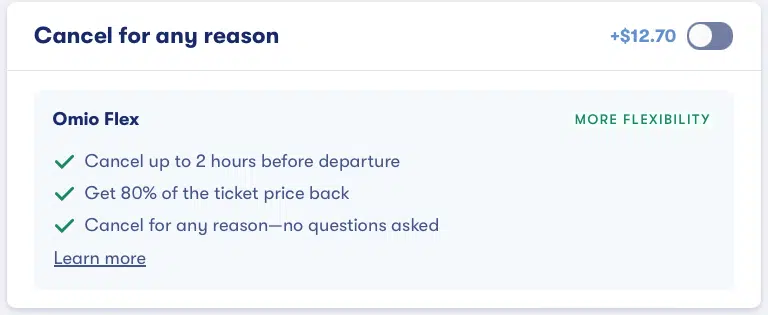
Unfortunately, the train tickets in Switzerland are typically non-refundable. And when you have to book months in advance to get the cheapest option, this can be risky in case something happens!
With Omio Flex, you can get 80% of the ticket price back, no questions asked, even if you cancel up to 2 hours before departure.
This is great peace of mind for a low cost, which, as I travel more and more, I realize is a very important thing to have!
In addition, I am an affiliate of Omio, so if you found this post helpful, you can support me (free of charge to you!) by booking your train tickets through my Omio links 🙂
Frequently Asked Questions
Is there a direct train from Zurich to Zermatt?
No, there’s no direct train from Zurich to Zermatt. Every route needs at least one change, almost always in Visp, where you switch to the red Matterhorn Gotthard Bahn for the last hour into Zermatt. Depending on which you book, you might have 2 or 3 transfers.
How long is the train from Zurich to Zermatt?
The train from Zurich to Zermatt takes about 3 to 3.5 hours. Routes with only one change (in Visp) are usually the fastest. Leaving from Zurich’s main station (Zürich HB) is slightly quicker than leaving from the airport.
How much is the train from Zurich to Zermatt?
With a Saver Day Pass booked in advance, it can be as low as CHF 52 (about $63 USD). A regular ticket bought a few days before can cost $150 or more, so booking early makes a big difference.
Is the Swiss Travel Pass worth it for Zurich to Zermatt?
For just this one journey, no. The Swiss Travel Pass usually only pays off if you’re taking a lot of trains, scenic routes or mountain excursions on consecutive days. For our 7-day trip with two big train journeys, Saver Day Passes were the cheapest option.
Do I need a seat reservation for the train to Zermatt?
No, you don’t need a seat reservation on the regular trains from Zurich to Zermatt. Your ticket or Saver Day Pass is all you need. Reservations are only required on special scenic trains like the Glacier Express.
Can you do Zermatt as a day trip from Zurich?
You can, but I don’t recommend it. With 3+ hours each way, you’d spend almost 7 hours on trains and have very little time in Zermatt. It’s much better to stay overnight in Zermatt, or ideally for a few days so you have a good chance of a clear day to see the Matterhorn!
Arriving in Zermatt
After about an hour winding through beautiful villages on the Matterhorn Gotthard Bahn from Visp, you’ll pull into Zermatt’s main train station, right at the edge of the town.
It’s important to know before you arrive that Zermatt is a car-free town. You won’t find regular taxis or Ubers waiting outside, just small electric taxis and hotel shuttles.
Depending on where you’re staying in Zermatt, you have three options:
- Walk: Most of the village is walkable from the station, and the main street (Bahnhofstrasse) starts right outside. Just keep in mind some streets are steep, and they can be icy in winter.
- Hotel shuttle: Many hotels offer a free electric shuttle from the station. Check with yours before you arrive and send them your train time.
- Electric taxi: You can sometimes find them outside the train station. If not, call one like Christophe’s e-taxis!
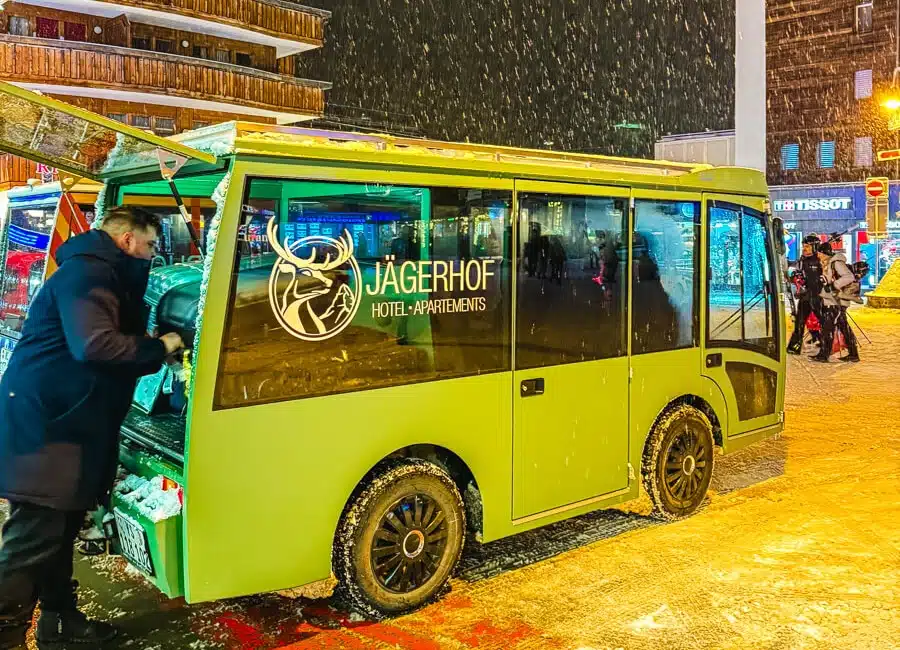
We personally stayed a little outside of town at Hotel Jagerhof on our trip to Zermatt, which was a 15-minute walk from the train station.
Luckily, Hotel Jagerhof offers complimentary pick-up from the train station upon arrival! This was extra nice for us because it started snowing as we arrived.
Now that you know how to get from Zurich to Zermatt by train, it’s time to start planning the Zermatt leg of your Swiss adventure.
Make sure to check out my 3 Day Zermatt itinerary and my guide on visiting Zermatt in Winter for more help!
And if you have any questions about this post (or anything related to Switzerland), feel free to leave a comment or send me an email!
Check out all of my Switzerland blog posts below! 🇨🇭❄️🫕
A Magical One Week Switzerland Winter Itinerary!
Visiting Zermatt in the Winter: Everything to Know Before You Go
3 Perfect Days In Zermatt, Switzerland In The Winter!
Where to Stay in Zermatt, Switzerland in Winter (with Map!)
15 Bucket List Things to Do in Zermatt in the Winter!
A Complete Guide to Skiing in Zermatt, Switzerland
What To Wear In Zermatt In Winter: Detailed Packing Guide!
Visiting Basel In December: Christmas Markets & Beyond
Basel Christmas Itinerary: 2 Days In Basel In December
Christmas Market Trip To Colmar & Strasbourg From Basel!
What To Wear To European Christmas Markets (Packing Guide)
Don’t forget to pin this post for future planning!