How to Get Around London (Tube, Bus, Boat, Bike + More)
In my opinion, navigating a new city can be one of the most stressful parts about visiting a new country.
What’s the most efficient way to get around? Are the trains safe? How much am I going to spend each day?
Luckily, getting around London is extremely easy, thanks to a combination of trains, buses, river cruises, and other methods of transport!
The last time we visited London, we were able to hit the ground running without any overwhelm – it was honestly easier than navigating NYC! And we learned a few tricks along the way to help save time (and steps!).
This guide will help you get acquainted with the many different ways to get around London, as well as payment methods and what to skip entirely, so once you arrive for your trip, you’re not stressing over Tube stations and bus routes.
London Trip Planning at a Glance
Don’t have a lot of time? Here’s a quick mini guide to London to help plan your epic adventure!

Where to Stay:
– The Z Hotel Covent Garden ($)
– Hilton Doubletree Marble Arch ($$)
– The Chesterfield Mayfair ($$$)
Things to Do:
– Westminster Walking Tour
– Ride bikes through Hyde Park
– Explore Soho and Covent Garden
– Thames River Cruise to Tower of London
– Eat your way through Borough Market
Read my full list of things to do here!
How We Got Around London
London, like many European cities, has a vast public transportation system that covers its 32 boroughs very well.
Each day, you’ll have the option of taking a train, a bus, a boat, a bike, a cab, or just walking!
During our 4 days in London, we personally used a mix of the Tube (aka the London Underground), the bus, e-bikes, one Thames river cruise, and a lot of walking, too!
I’ll share all the details of each option with my honest pros and cons below, but here’s a quick table with their cost and my personal take on when to use them first!
| Option | Best For | Cost | My Take |
|---|---|---|---|
| Tube (Underground) | Longer distances across the city | ~£3 | Fastest for far trips, but station time adds up |
| Bus | Direct routes and seeing the city | ~£2 | Our favorite! Cheaper and fun views |
| Walking | Exploring one neighborhood at a time | Free | A must in Westminster, South Bank, and Covent Garden |
| E-Bike | Hyde Park and the Royal Parks | £3 per 30 minutes | One of my favorite things we did! |
| River Cruise | Sightseeing between Westminster and the Tower | £10-£20 | Touristy, but we loved it for certain routes |
| Uber / Black Cab | Late nights and heavy luggage | Varies by route | Pricey, only in a pinch |
| Rental Car | Day trips into the countryside only | ££££ | Skip it in the city |
Must-Knows (Oyster Card & Contactless Payment)
One of the things I love most about London’s transportation system is how up to date and streamlined the payment systems are!
Unlike Paris, where you had to buy paper tickets up until a few years ago, London is way ahead of the times with contactless payment on both trains and buses! This means you can use both a contactless credit card or just use your Apple/Google Pay.
You used to have to purchase a Visitor Oyster Card in London, which is a reloadable transit card. This is still an option if you don’t have a contactless payment method or if your bank charges foreign transaction fees.
But for most people, you won’t need an Oyster card and can just use your phone/card!
P.S. I use my Capital One travel cards for all international travel because it has 0 foreign transaction fees. I highly recommend getting the Venture or Venture X Card for this perk and so many more!
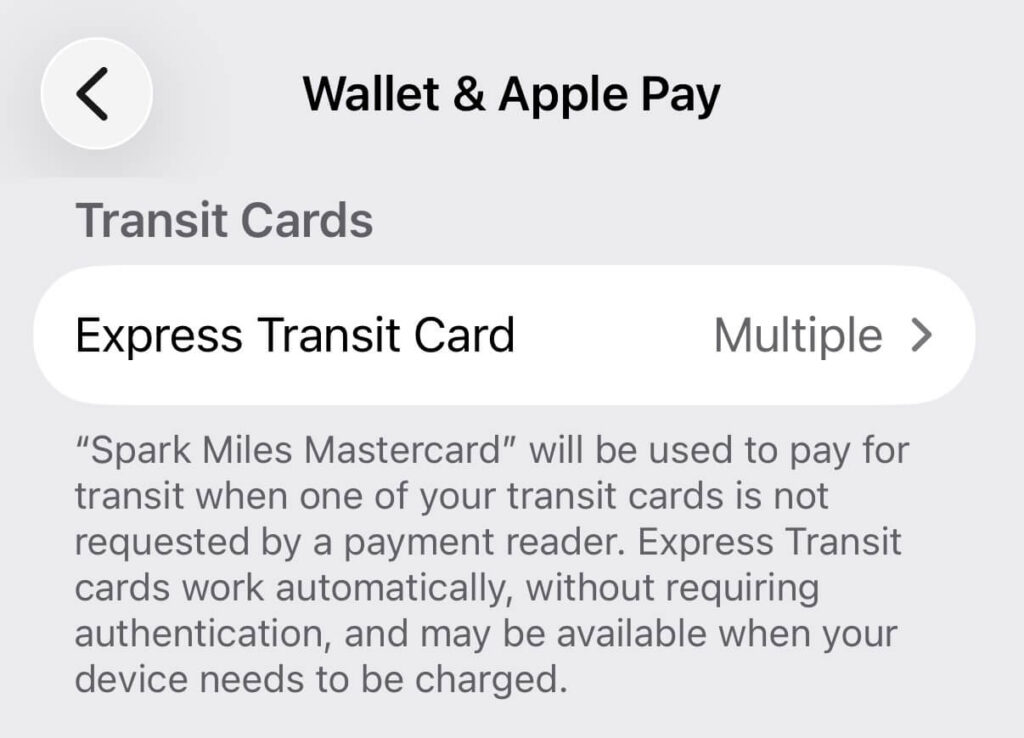
If you have an iPhone, navigate to your Wallet in Settings, and then scroll down to the “Transit Cards” section. Here, you can select which card you want to use for transportation readers.
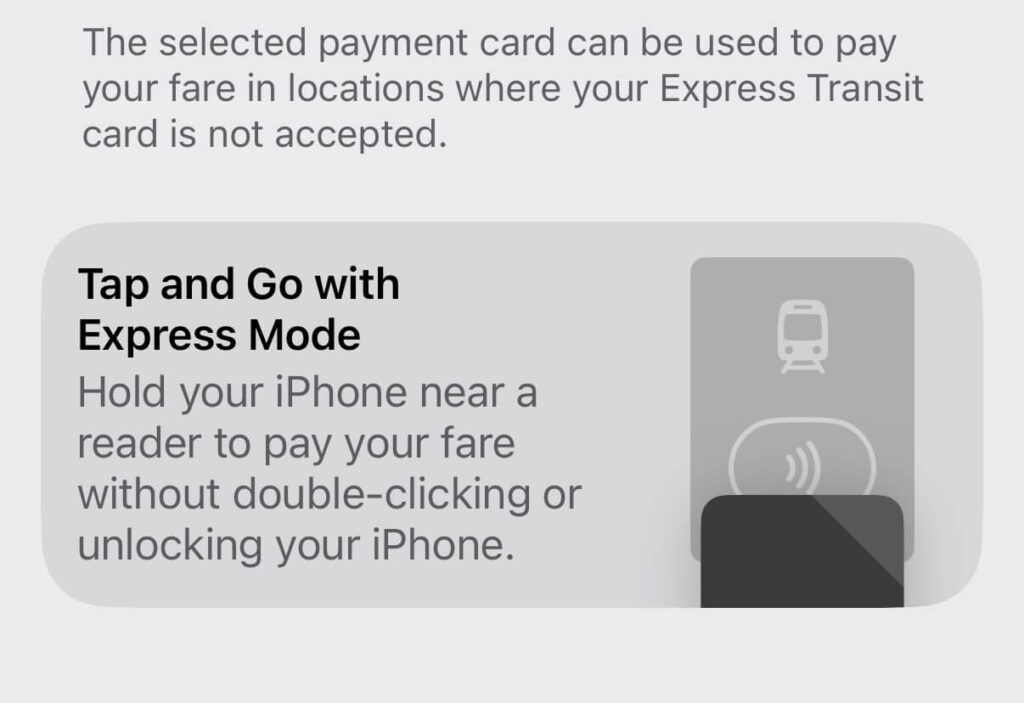
And the best part is the “Express Transit Card” feature, where you don’t need to unlock your phone. Just hover it over the reader and go!
Here are some other things to know about navigating trains and buses with contactless payment:
- Everyone needs their own card or phone. You can’t tap the same card twice for two people.
- Tap in AND out on the Tube. If you forget to tap out, you’ll be charged the maximum fare. On buses, you only tap once when you get on.
- Use the same card or phone all day. London caps how much you pay per day, but only if every tap is on the same card or device. Switching between your phone and the physical card means the cap won’t kick in.
How to Choose the Best Way to Get Around Each Day
When deciding how to get around London each day of your trip, it really depends on where you are starting and where you are going!
This may seem obvious, lol, but I highly recommend using Google Maps or Citymapper while in London to help you decide for each journey.
Plug in your origin and your destination, and the app will show you the different route options with times via public transport, including both buses and trains, as well as walking!
P.S. You’ll need data for this, so I recommend either an e-sim or an international phone plan. I cover both of these in my $7 Passport to Confidence Guide, which helps you plan your dream international trip with zero stress!
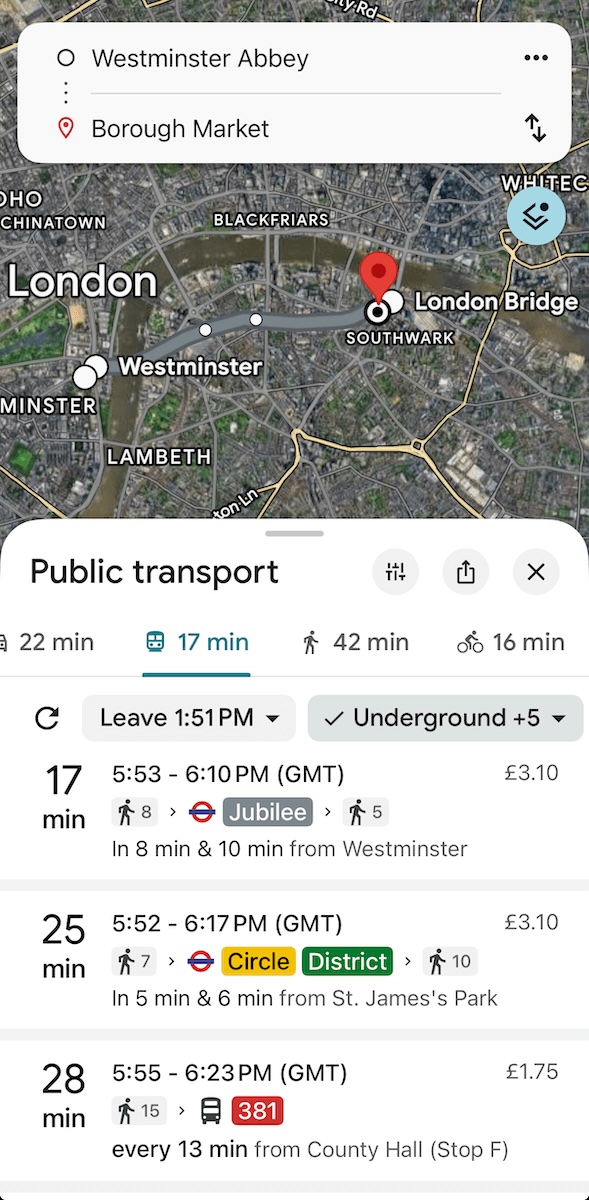
Typically, the fastest route will be via the Tube, but not always. We were pleasantly surprised multiple times on our trip that there was a direct bus route from Point A to Point B.
And when you factor in the walking time to and through the train station, including the time it takes to get to the actual platform, sometimes the bus is faster.
Of course, buses are more impacted by traffic, rush hour, and delays, so keep that in mind. We found the trains to be much more punctual than the buses!
For example, Google Maps may say a bus is arriving in 4 minutes, then quickly jump to 10 minutes due to traffic delays. So if you’re on a tight schedule (like a timed entry ticket or a show), take the Tube.
And lastly, we chose to walk instead of ride the train or bus a handful of times, especially when the walk was only 5-10 minutes longer than public transportation. Might as well enjoy the beautiful London scenery, right?!
London by Tube
The London Underground, better known as “the Tube,” is an underground train system and is the fastest way to cover longer distances in London.
(There’s also an Overground system, but it’s unlikely you will use those trains unless you are leaving the city proper).
The Underground has 11 color-coded lines and over 270 stations – check out the screenshot for Central London’s map below, or view the entire map here.
Tube fares are determined by what zone you are riding to/from. Most tourists will not leave Zone 1 (shown by the white background in the map below).
A single fare in Zone 1 is £3.10 during peak hours and £3.00 during non-peak hours. However, there is a daily cap of £8.90 for Zone 1, so you will not be charged more than that per day, no matter how often you ride!
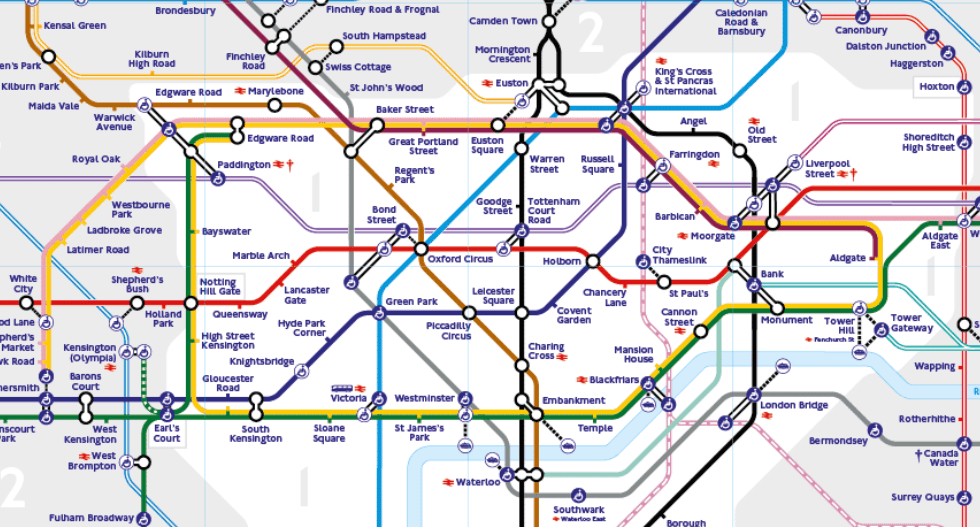
One of my biggest tips for visiting London for the first time is to pick a hotel near a Tube station to make your life easier.
We personally stayed at the Hilton DoubleTree Marble Arch near the Marble Arch Station on the Central (red) line, which runs east-west across the center of this city (hence the name). It was also a 10-minute walk from Bond Street Station!
To go north/south from here, we could transfer easily to the Victoria, Bakerloo, or Jubilee lines as needed!
🏨 For more hotel recommendations near tube stations, check out my full guide on Where to Stay in London!
How to Ride the Tube in London
If you’ve been on public trains in other cities like New York or Paris before, riding the Tube in London is very similar.
From the street, look for the iconic Tube symbol, a red circle with a royal blue line through it with the station name, which marks the entrance to the station!

You’ll descend via stairs (sometimes escalators) underground and navigate to the platform your train leaves from.
Like other cities, it’s important to pay attention to your train and platform name before proceeding through the turnstiles, as some stations have multiple entrances depending on which train you’re boarding.
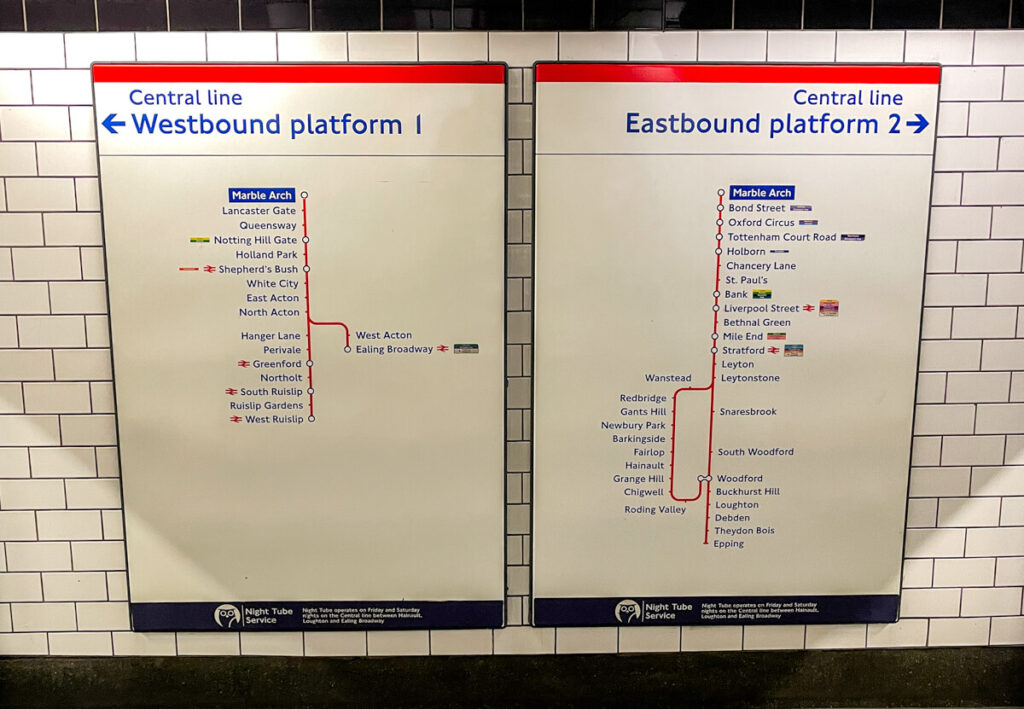
Look for both the name of the train (or color), like the red Central line, as well as the direction you are heading, which is normally designated by the end stations on that line.
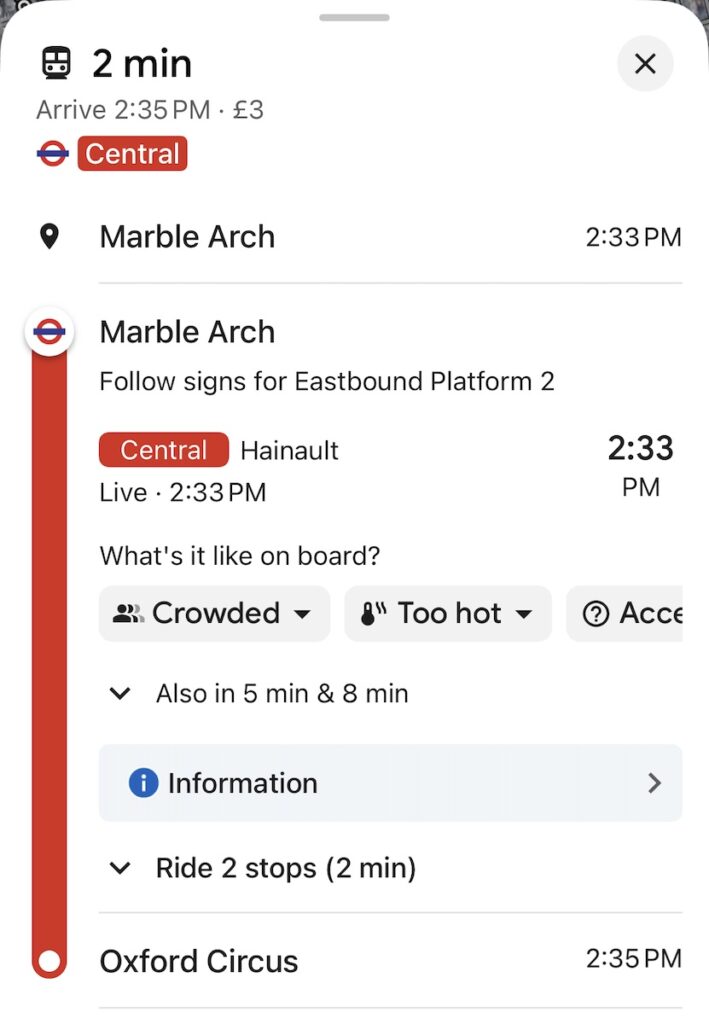
For example, if you are boarding the Central (red) line at Marble Arch and looking to go to Oxford Circus, you’ll look for signs for the Eastbound platform. This will be notated on your Google Maps so you easily know what to look for!
In addition to the direction, your train will also include the name of a stop towards the end of the line, so you know which direction it is headed. For the example above, you may see “Hainault”, “Epping”, or “Newbury Park”, which are all stops on that line!
Other Trains in London
As mentioned, there are other train lines throughout London besides the Underground, including the Overground and other speciality train lines.
The Overground includes 6 different lines that cover the greater London area. However, unless you are leaving Central London, as a tourist, you probably will not use the Overground.
One speciality line that you may use as a tourist is the purple Elizabeth line. While technically not part of the Tube, this line connects with many Tube stations and is a faster option across central London (and costs the same).
The most common use of the Elizabeth line, however, is to get to and from London Heathrow Airport. This journey is faster than taking the standard Piccadilly line (30 minutes versus 50 minutes), but it does cost over double (£15 vs £6).
You can read more about the different options for getting from Heathrow to the City Center in my guide here (coming soon!).
London by Bus
One of the biggest mistakes people make when visiting London is avoiding the bus!
We actually took the bus multiple times during our last visit to London, as our hotel was right next to two different bus stops (while the Tube station was a 5-minute walk).
For example, when trying to get down to Westminster Abbey from our hotel, it was faster (and much less walking!) to take Bus Line 148 from the Marble Arch stop, which dropped us right at the foot of the Abbey.
After a few days of walking to/from the Tube Station and climbing lots of stairs, we really came to appreciate the convenience of the bus!
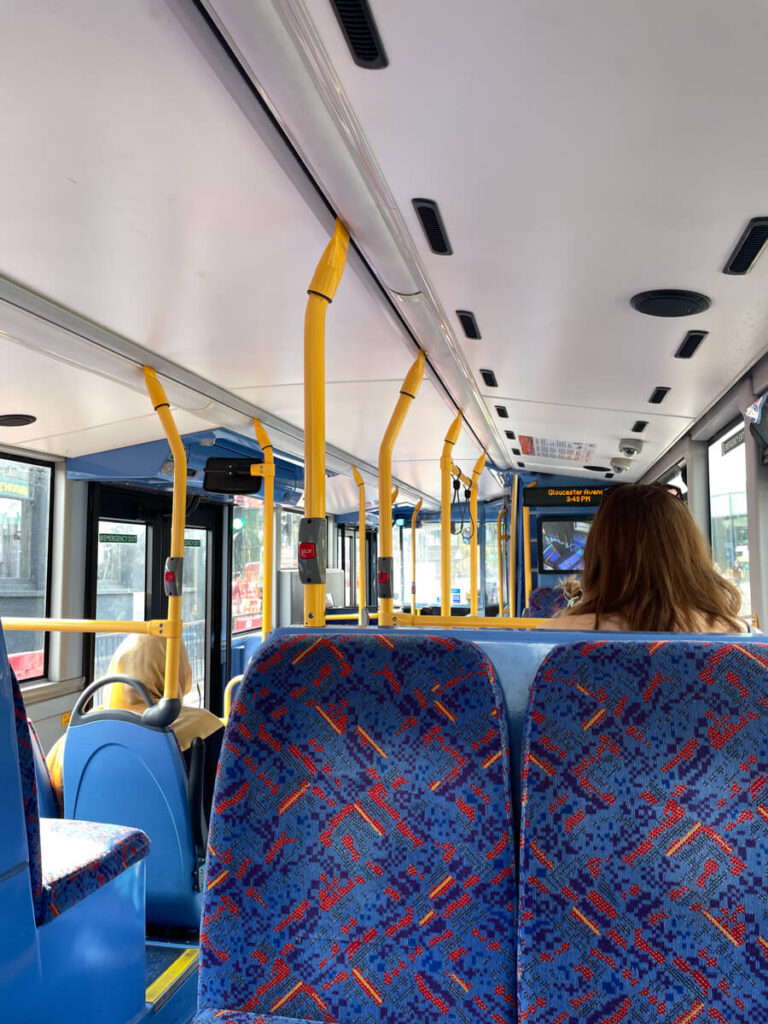
Not to mention, the public buses in London are the classic red, double-decker buses you see on postcards, souvenirs, etc. It was very fun riding on the second floor of the bus, especially if you can snag the seats right at the front in front of the big window!
And of course, the views from the buses are much better than the views from the London Underground!

There are over 600 bus routes throughout London, but don’t let that overwhelm you. There are a handful of high-frequency routes that run through the Central London tourist district, and you really don’t need to know which they are until you’re riding them!
This cartoon map is a great simplification of those bus routes with notable London landmarks.
A standard bus fare in Central London is £1.85. But even better, bus transfers are free within an hour (called the Hopper fare). This means you can take unlimited buses within one hour of your first tap for the price of one ride.
There is also a daily cap on bus fare of £5.55, so you shouldn’t ever pay more than that.
How to Ride the Bus in London
Riding the bus in London is even easier than taking the Tube, in my opinion. There are no complicated stations to navigate through.
Bus stops are easily noticeable on the street with their red and white signs (the symbol looks very similar to the London Underground symbol, just all red).
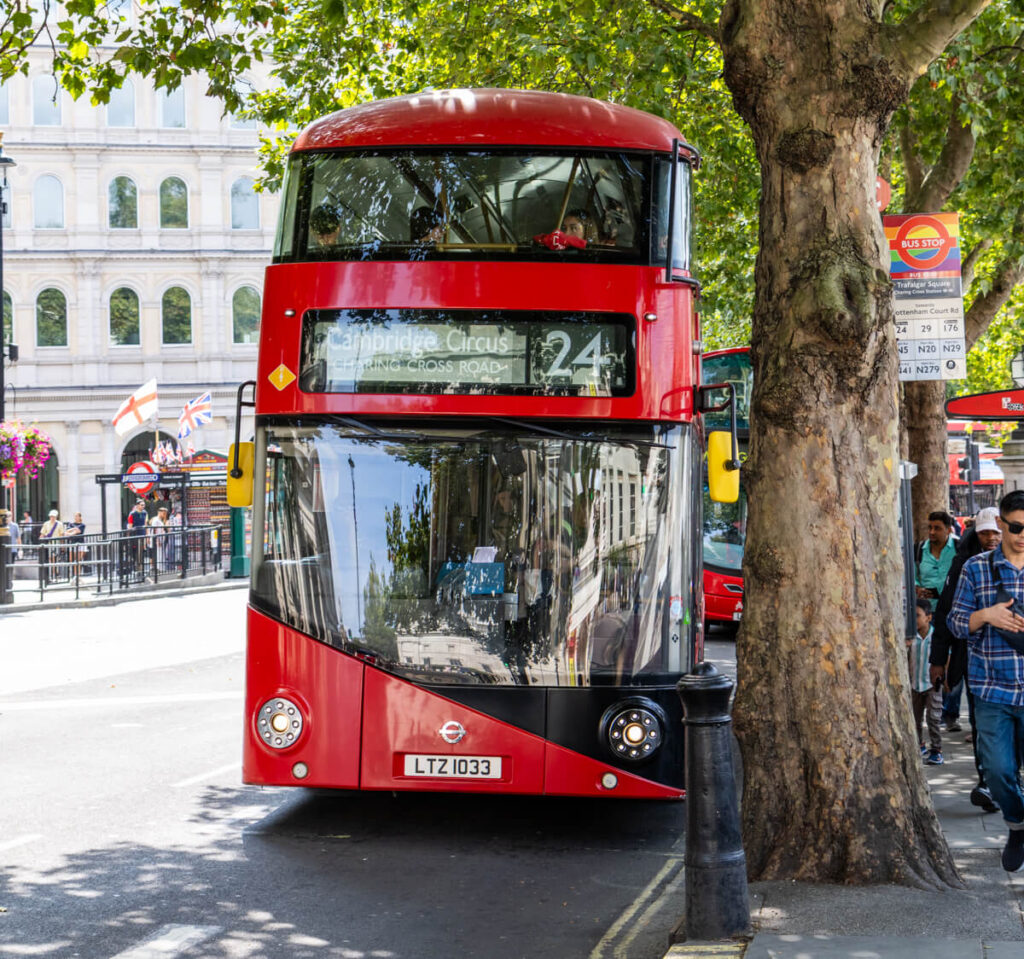
Most bus stops also have a glass seating area like you normally see in big cities.
Buses are easily identifiable as they’re approaching, thanks to the number and direction displayed at the front of the bus. Just make sure you’re on the right side of the street for the direction you want to go!
When boarding, you’ll tap your phone or card at the contactless payment pad. However, unlike the Tube, you do not need to tap out when you get off the bus!
London by River Cruise
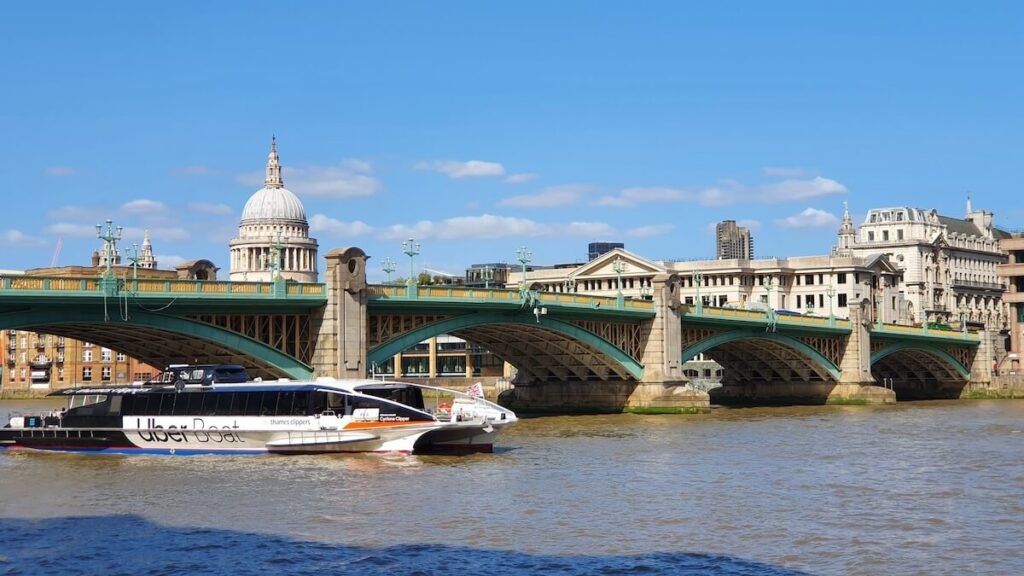
Uber Boats by Thames Clippers
If you get sick of trains and buses, London has alternative means of travel: cruising down the River Thames by boat!!
I actually had no idea this existed until my last trip to London, when we saw “Uber boats” along the river and I looked it up.
These Uber boats are run by Thames Clippers, but they operate in coordination with the official London transport network.
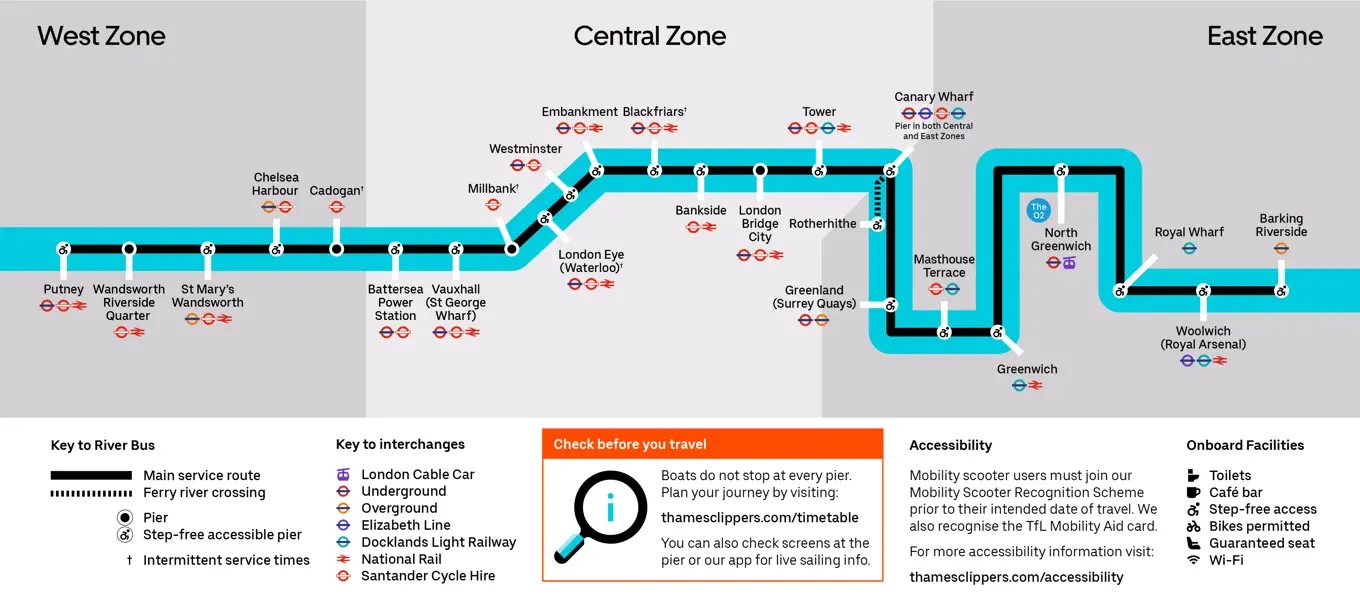
The boats are exactly what they sound like: public boats (more like small ferries) that run up and down the Thames, stopping at 24 different piers where you can board or disembark.
Similar to the Tube, the river boats operate based on Zones, with most of the tourist areas falling in the “Central Zone” – see map below!
Save this post for later!
Ticket prices for these river boats vary based on how you purchase them. Tickets are cheaper if you purchase them in advance online, and more expensive if you wait to buy tickets at the dock.
However, you also have the option of forgoing the tickets altogether and using contactless payment, just like with buses and trains.
Here’s a quick look at the fares for the Central Zone based on how you purchase:
- Single Route purchased at Pier: £16.40
- Single Route purchased online/in app: £11.70
- Single Route via contactless payment: £9.90
So, it is actually cheaper to just use your contactless card or phone to pay, which is a nice bonus!
These boats run fairly frequently as well, departing every 20 to 60 minutes, depending on the time of day and week! You can view the full timetable here.
Sightseeing Boats
Full transparency, we didn’t actually ride the Uber boats while in London (because I didn’t know they existed until we got there, lol).
Instead, we booked a sightseeing boat for our first morning in London, which was touristy but so so fun!
Similar to the public boats, there are several private sightseeing boat companies that run the same route up and down the Thames, stopping at the most popular piers like Westminster, London Eye, Greenwich, and Tower.
We chose this specific company due to their low costs and because we wanted some live commentary as we cruised down the river! Their boats leave about every 40 minutes, depending on the exact route.
Note: We actually booked a one-way cruise that was somehow more expensive than this hop-on hop-off unlimited option. I highly recommend booking this option via GetYourGuide instead, as it’s the best bang for your buck!
Our cruise included the journey from Westminster Pier to Butler’s Wharf Pier (the one next to Tower Bridge and Tower of London). We were spoiled with a beautiful sunny day and perfect temperatures, which made the ride on the rooftop even more enjoyable.


When to Ride The River Boats
Both the Uber Boat and the sightseeing cruises are great options for a change of scenery in your London transportation journey.
However, more often than not, I don’t recommend using them in place of the Tube or the bus. Why?
Well, the route down the Thames is really only convenient if you are going to specific landmarks in London. Yes, a lot of the top things to do in London lay along the Thames, but not everything!
For example, I think a river boat cruise is perfect to travel between Westminster area (near Big Ben) down to Tower Bridge.


This journey offers incredible views along the river, and you’ll get to see all the important landmarks, including Big Ben, the London Eye, downtown London, the HMS Belfast, and of course, some famous bridges!!
In my opinion, you only need to do this journey one way, but feel free to do it round-trip if you want to soak in more views, especially if you’ve booked this unlimited rides option!
On the other hand, if you are trying to get from Westminster to Hyde Park or Covent Garden, a boat cruise makes no sense!
Uber Boat vs Sightseeing Cruise
So, should you book the Uber Boat or a tourist sightseeing cruise?
In my opinion, the sightseeing cruise is 100% worth doing over the Uber Boats, especially since this unlimited option is cheaper than a one-way Uber Boat!! But besides money, I have a few other reasons for this opinion.
First, we loved being able to sit on the top deck of the sightseeing cruise boat and enjoy the fresh air. The Uber boats are fully enclosed, which in my opinion, is a less magical experience. (Unless the weather is bad, then it’s a perk! lol).
Secondly, we loved the live commentary from the tour guide on the sightseeing cruise. Yes, it’s cheesy and full of tourists, but it’s still very fun and educational!
We learned so much about London and the landmarks we were passing during the 30 minutes on the boat.
Whereas if you book the Uber Boat, you will be passing a ton of history without knowing the significance!

Lastly, because it is a tourist boat, they know everyone wants pictures of the iconic Tower Bridge from the water (like the one above), so the captain approaches the bridge and then slowly turns the boat around so everyone can get the perfect angle from their seat!
You won’t get that kind of dedication on a normal Uber Boat!
In short: my recommendation is to book this sightseeing cruise for the journey from Westminster to Tower Bridge, and then explore the Tower of London and Tower Bridge area! ⛴️
London on Foot
While taking a boat, train, or bus is a nice way to give your feet a break when in London, some areas deserve to be explored on foot!
Plus, this is the best way to really get to experience the city, not constantly stuck in Tube stations!
Our typical approach was to use public transportation to get between neighborhoods, and then explore on foot once we got to each neighborhood.
Usually if the walk was more than 20-30 minutes, we would hop on a train or bus, unless our feet were fresh! This is especially nice when the train ride for that same distance is only 3 minutes.


A few tips for walking around London:
- Look both ways before crossing. Cars drive on the left, which is the opposite of the US. Many crosswalks even have “Look Left” or “Look Right” painted on the ground!
- Wear comfortable shoes. You’ll walk a lot more than you expect, even with public transportation!
- Consider a walking tour. I usually do one on my first day in a new city, but I skipped it in London, and I regret it! Walking around Westminster on our own, I felt like I was missing out on so much history. Next time, I’d book a Westminster walking tour like this one.
In terms of what areas to explore on foot, here were our favorite neighborhoods and routes that definitely deserve a spot on your walking list:
- Westminster: Big Ben, Westminster Abbey, Buckingham Palace, and St. James’s Park are all within a few minutes of each other. This is a must-do while in London! Best experienced on a walking tour, like I mentioned above!
- Westminster Bridge to South Bank: Stroll across the Westminster Bridge to the London Eye and then down the river to Shakespeare’s Globe and Tate Modern. Make sure to get a photo of the Houses of Parliament and Big Ben from across the Westminster Bridge!
- Covent Garden and Soho: Covent Garden Market, Leicester Square, Piccadilly Circus, and Trafalgar Square are all a short walk apart and easy to do in one afternoon.
- Tower of London to Borough Market: After riding the boat from Westminster to Tower of London, we then walked from Tower of London to Borough Market across the Thames! You can do the shorter route across the London Bridge or the longer (but more iconic) route across the Tower Bridge!

London by Bike
Another great way to explore London is via bike!
This was my first time renting a bike in a foreign city, and it was surprisingly easy! Thankfully, London is extremely bike friendly, with dedicated bike lanes and stoplights for bikes that make it very foolproof to navigate around.
Now, that doesn’t mean I’d go biking in congested areas like Trafalgar Square or around Westminster. However, London does have lots of green spaces that are perfect for a morning bike route.
We personally decided to explore Hyde Park down to Buckingham Palace on bikes, which I think is the ideal route for beginners (more on that below)!
We rented some e-bikes from the bike share company Santander, which you will see very frequently around town.
These are managed in accordance with London transport, so the prices are well-regulated.
E-bikes cost £3 for up to 30 minutes, and then £3 for each additional 30 minutes. Or, you can purchase a day pass for £4.50 for unlimited 60-minute rides. (They also have standard bikes for a bit cheaper).
While not the cheapest transport option, it’s a great way to get some exercise and give your feet a break.
Recommended Bike Route
After grabbing our bikes, we rode down from the northeast end of Hyde Park all the way to the bottom (southeast) end.

From there, we continued on past Wellington Arch, through Green Park on Constitution Hill road, and then took a quick rest stop at Buckingham Palace (we had already explored here the day before during the Changing of the Guard ceremony).
From Buckingham Palace, we rode back up through the south side of Hyde Park to Kensington Gardens, where we got off our bikes and explored the gardens and Kensington Palace on foot!
In my opinion, this is the perfect route for exploring London via bike, as there is minimal traffic (mostly park roads) and you’ll cover a lot of ground much faster than walking the whole thing!
🚲 Tip: You can set your Google Maps to bike mode for turn-by-turn directions and help sticking to the bike paths!

Dedicated bike lane near Buckingham Palace Beautiful blooming Kensington Gardens


London by Uber / Cab
Last but not least, London also has their iconic black cabs, as well as Ubers, if you don’t want to use public transportation.
However, this is definitely the most expensive option, so I don’t recommend it for daily use, unless you have a specific reason (like mobility issues, etc).
Black cabs can be hailed on the street when the orange “TAXI” light on top is on. Drivers know the city incredibly well (they have to pass a famously difficult test called “The Knowledge”)!


Uber works in London just like at home, and it’s usually a bit cheaper than a black cab. Prices do surge at busy times, though.
In both cases, London traffic can be slow, especially in the city center during the day. A quick Tube ride can take much longer by car.
Tipping isn’t expected, but rounding up to the nearest pound for a black cab is appreciated!
Should You Rent a Car in London?
Short answer? No! Unless you’re heading out into the countryside, you should definitely skip the rental car in London.
As you can tell by this post, there are soo many different ways to get around London thanks to the incredible public transportation system, plus bikes and your own two feet!
London is not a car-friendly town, especially for tourists, who are used to driving on the right side of the road.
It’s also notoriously expensive to both drive and park in London, and you’ll likely spend more time in traffic than actually exploring.
The exception: If you’re planning a day trip to somewhere like the Cotswolds, renting a car makes it much easier to hop between villages, since getting there by public transport takes a train and a bus.
In that case, pick up your rental car on your way out of London (or at the airport) instead of driving in the city.
For most day trips, like Windsor, Oxford, or Bath, the train is easy and direct, or you can book a guided tour and skip the logistics altogether.
Just make sure to leave room for them in your itinerary! Here’s how many days you need in London to fit in a day trip or two.
Frequently Asked Questions
What is the best way to get around London?
The best way to get around London is a combination of the Tube, buses, and walking. Take the Tube for longer distances, the bus for direct routes, and walk once you’re in the area you want to explore.
Do I need an Oyster card in London?
Not anymore! You can tap a contactless credit card or your phone on the Tube and buses for the same fares as an Oyster card. An Oyster card only makes sense if you don’t have a contactless card or your card charges foreign transaction fees.
Is London walkable?
Central neighborhoods like Westminster, South Bank, and Covent Garden are very walkable. But London as a whole is too big to walk everywhere, so you’ll want to use public transportation between areas.
Is the Tube safe at night?
In my experience, yes! I felt very safe riding the Tube in London, even at night. As in any big city, keep an eye on your belongings in crowded stations.
Final Thoughts
Getting around London is a lot easier than it seems at first, especially once you know the different options and when each one makes sense.
My biggest tips are to use contactless instead of buying an Oyster card, check Google Maps (with buses turned on) before every journey, and plan your days by neighborhood so you can walk between sights easily!
And if you can, rent e-bikes to see Hyde Park and Kensington Gardens, and ride the river cruise from Westminster to the Tower of London for a bit of extra fun.
For more help planning your trip, check out my 2 day London itinerary and my 4 day London itinerary to see exactly how I recommend getting around and planning out your days!
Read More London Blog Posts Below ⬇️🇬🇧
Action-Packed 2 Day London Itinerary
Perfect 4 Day London Itinerary for First Timers
Epic 7 Day London and Paris Itinerary!
Traveling To London For The First Time: A Beginner’s Guide
Where To Stay In London For First Timers: Breakdown By Neighborhood
30 Fun & Unique Things to Do in London for First-Timers!
Don’t forget to pin this post for future planning!